
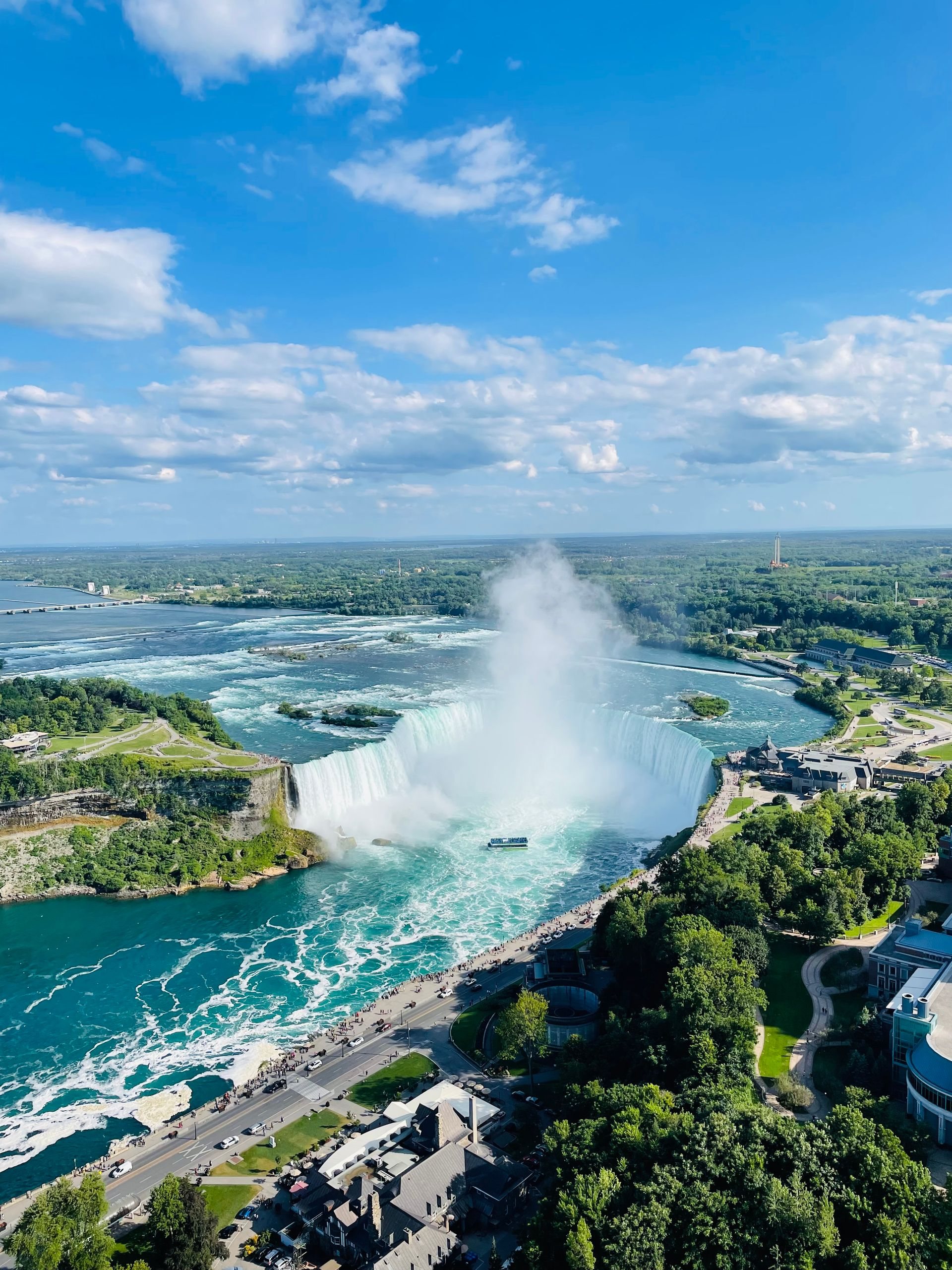
Niagara Falls is one of the most famous natural wonders on Earth — but most visitors know surprisingly little about it. Here are the numbers, the geology and the wild stories behind the Falls, answered simply.
Quick Facts Table
| Fact | Answer |
|---|---|
| How many waterfalls? | Three: Horseshoe Falls, American Falls and Bridal Veil Falls |
| How tall is the Horseshoe Falls? | About 57 m (187 ft) |
| How tall is the American Falls? | About 21–30 m (70–100 ft) to the rocks at its base |
| How wide is the Horseshoe Falls? | Roughly 790 m (2,600 ft) along its curved crest |
| How wide is the American Falls? | About 320 m (1,050 ft) |
| Average water flow | About 2,400 m³ per second (85,000 cubic ft/s) |
| How old is it? | Roughly 10,000–12,000 years, formed after the last Ice Age |
| Which country owns it? | Both — the border runs through the Horseshoe Falls |
How Tall Is Niagara Falls?
The Horseshoe Falls drops about 57 metres (187 feet). That isn’t especially tall by world standards — Angel Falls in Venezuela is over 900 m — but Niagara is famous for its volume, not its height. The American and Bridal Veil Falls look shorter because a huge pile of fallen rock (talus) sits at their base.
How Much Water Goes Over Niagara Falls?
- On average around 2,400 cubic metres every second — enough to fill an Olympic swimming pool in about one second.
- The highest flow ever recorded was about 6,370 m³/s.
- About 90% of the water goes over the Horseshoe Falls.
Why is there less water at night?
A 1950 treaty between Canada and the U.S. lets hydroelectric plants divert a large share of the Niagara River. To protect the view, at least 2,800 m³/s must flow over the Falls during daytime in the tourist season (April–October), and at least half that at night and in the off-season. So yes — the Falls are literally “turned down” at night.
How Were the Falls Formed?
When glaciers retreated at the end of the last Ice Age, meltwater from what became Lake Erie spilled over the Niagara Escarpment toward Lake Ontario. Over thousands of years the waterfall has eroded upstream, carving the 11-km Niagara Gorge. Erosion was once over a metre a year; thanks to water diversion and engineering it’s now roughly 30 cm (1 ft) per year.
Has Niagara Falls Ever Frozen or Stopped?
- March 1848: an ice jam near Lake Erie blocked the river and the Falls slowed to a trickle for about a day and a half — people walked on the riverbed.
- 1969: engineers deliberately “turned off” the American Falls for several months with a temporary dam to study the rock face.
- Every cold winter: the Falls look frozen as mist builds huge ice formations — but water keeps flowing underneath. See Niagara Falls in winter.
Famous Daredevils
- 1859 — Charles Blondin crossed the gorge on a tightrope, later doing it blindfolded and even carrying his manager.
- 1901 — Annie Edson Taylor, a 63-year-old teacher, became the first person to go over the Horseshoe Falls in a barrel and survive.
- 1960 — “The Miracle at Niagara”: seven-year-old Roger Woodward survived going over the Horseshoe Falls wearing only a life jacket after a boating accident.
- 2012 — Nik Wallenda walked a tightrope directly over the Falls, with special permission from both countries.
Stunting is illegal today and carries heavy fines. More stories in our Niagara Falls history guide.
More Surprising Facts
- The Niagara River is only about 58 km long, connecting Lake Erie and Lake Ontario.
- Four of the five Great Lakes drain through Niagara.
- The first Niagara hydroelectric plants helped power the growth of Buffalo and Toronto — visit the Niagara Parks Power Station to see one.
- The river below the Falls is roughly as deep as the Falls are tall.
- The Falls are lit up every night of the year — see the illumination & fireworks schedule.
- Niagara Falls draws millions of visitors a year, making it one of the most-visited attractions in North America.
- The Whirlpool Aero Car crosses the Canada–U.S. border four times without leaving Canada — here’s how.
FAQ
Is Niagara Falls the biggest waterfall in the world?
No. It’s not the tallest or the widest, but it has one of the highest flow rates of any waterfall in North America, which is why it feels so powerful.
Can you swim at Niagara Falls?
No. Swimming in the Niagara River near the Falls is illegal and extremely dangerous because of the powerful currents and rapids.
Is Niagara Falls in Canada or the USA?
Both. The American and Bridal Veil Falls are in New York State; most of the Horseshoe Falls is in Ontario, Canada. Compare the sides in Canada vs USA.